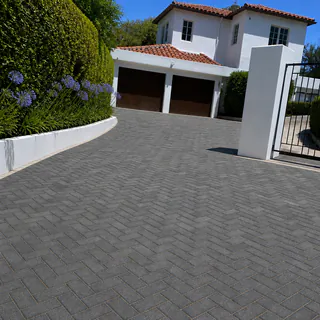
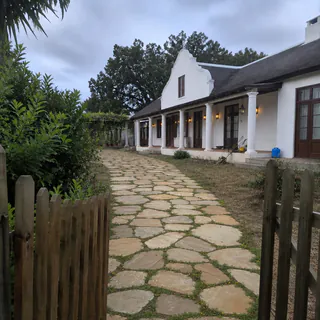
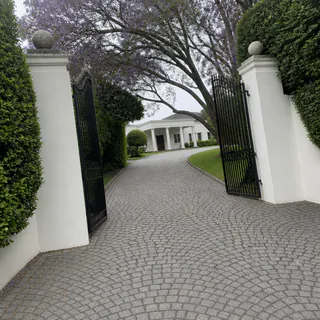
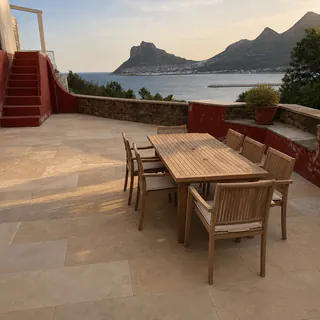
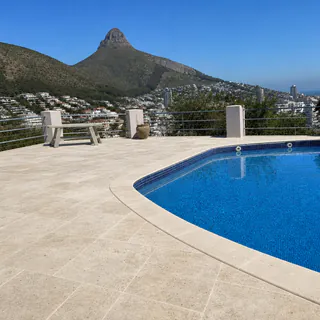
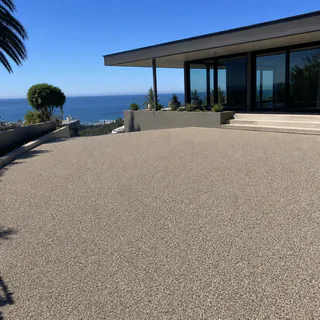
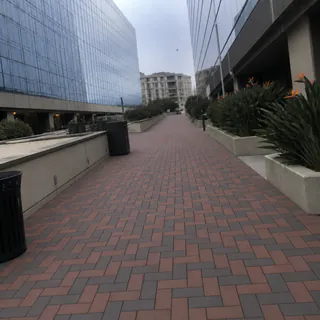
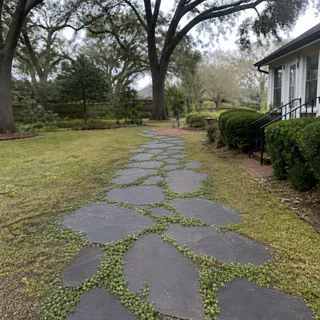
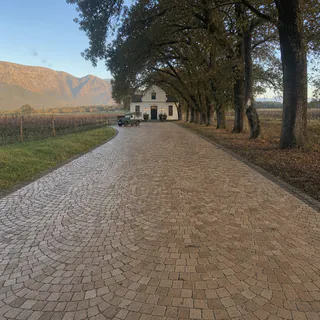
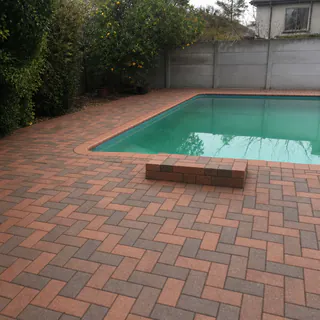
A patio is the part of the garden you actually use: the braai, the table, the walk out to the pool. We lay patios across Cape Town in natural sandstone, travertine, porcelain, clay brick and concrete cobble, each on its own base and joint detail.
We measure the area, agree where the water will run, and give you a written quote with the base, bedding, paving and jointing on separate lines. That is how we put a paving price together, and the visit is free.
The short version
- Choose on looks. See a physical sample in your own light before you commit.
- Grip belongs to the product. Near a pool, ask for the tested wet slip rating of the exact range, in writing.
- Each material has its own bed. Concrete cobble on bedding sand screeded to 25mm after compaction (CMA), clay brick on 30mm, also after compaction (Clay Brick Association), stone and porcelain on mortar over concrete.
- Water runs away from the house. The Concrete Manufacturers Association (CMA) sets a minimum fall of 2% for block paving.
- No rate card. You get a written price after we have measured your patio.
When To Repave Your Patio
Rocking pavers, standing water and dark staining point to different fixes, and not every tired patio has to come up.
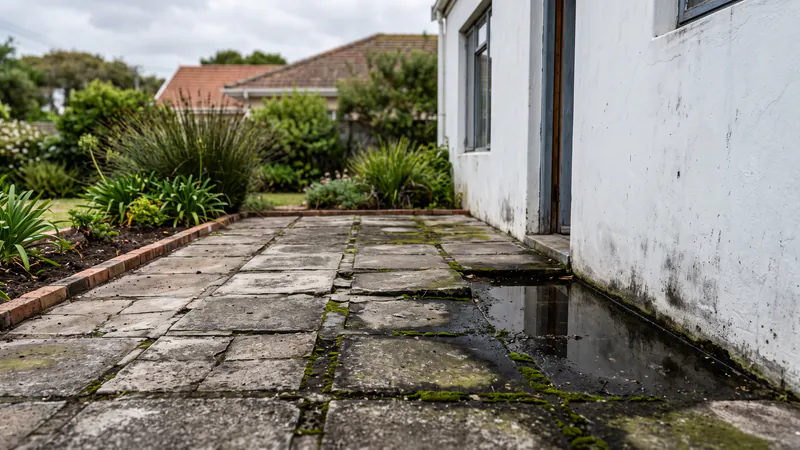
Lifting or rocking pavers
If a paver tips when you stand on it, the bedding or base under it has moved. Where that is confined to one area, relaying only the section that has moved may be all it needs.
Black mould or moss in joints
The Clay Brick Association says moss on clay paving doesn't damage it but can make it slippery: brush it dry, then test a fungicide on a small patch. On stone or porcelain, follow the supplier. Try cleaning and keeping the joints topped up before anyone quotes a relay.
Chipped or cracked pavers
A few damaged units can be lifted out and replaced; on mortar-set stone or porcelain that is more specialist work. If the damage is widespread and you want a new material, choose on looks and ask for the product's data sheet.
Pooling water against the house
The CMA's minimum fall for block paving is 2%, and it puts most pavement failures down to water getting into the layers underneath. A patio that holds water needs its levels put right, whether that is the fall or a dip that has sunk.
Choosing Your Patio Material
Pick the look that suits the house and the upkeep you will do, then get the exact range written on the quote.
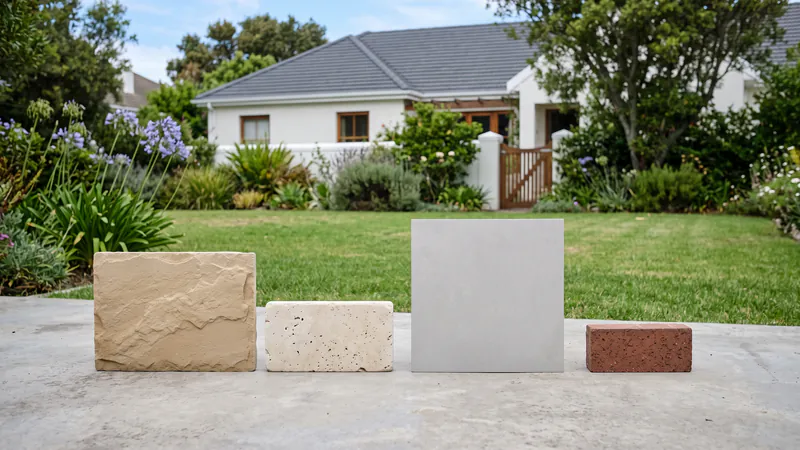
Natural sandstone
An earthy natural stone, no two pieces alike. We joint cut sandstone with mortar; sealing depends on the stone, so follow the supplier.
Tumbled travertine
A pale, textured limestone with small visible pores. It is porous, so plan on a sealer re-applied as the product says.
Outdoor porcelain
Uniform pieces with tight, even joints, including large formats. Choose a range sold for outdoor use and check its data sheet on sealing.
Clay brick
Fired clay with a traditional look and its own Clay Brick Association paving guide. We lay it on a sand bed, like concrete cobble.
Beside a pool, ask for the tested wet slip rating of the exact range. Weighing up travertine, slate and porcelain for a pool deck goes further, and paving that runs right to the water is a pool surround with its own coping detail.
Patio Materials We Work With
What Goes Under Your Patio
Sand-bedded and mortar-set patios are built differently, and your quote names the base, bedding and joint for yours.
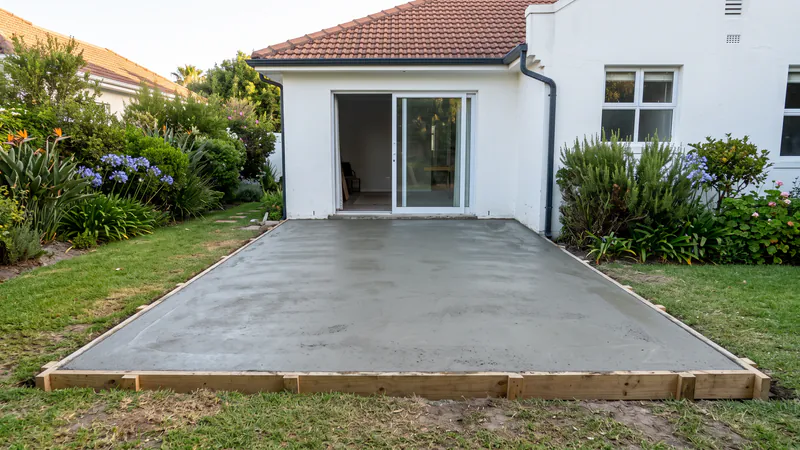
- Base: compacted G5 layers under a sand bed, or a concrete base where the paving is set in mortar.
- Concrete cobble: bedding sand screeded loose to give 25mm after compaction, 10mm either way (CMA), never used to fill hollows in the base.
- Clay brick: the Clay Brick Association's guide specifies bedding sand 30mm thick after compaction.
- Sandstone and porcelain: bedding mortar over a concrete base, to the range's installation guidance. The CMA's sand figures are for concrete blocks, not these.
- Falls: at least 2% (the CMA's block paving minimum), away from the house.
- Joints: jointing sand finer than the bedding sand on cobble (CMA), mortar on cut sandstone, a narrow grout on porcelain.
Before you sign off any patio, a bucket of water at each door threshold shows which way the falls really run.
How We Build Your Patio
Five stages, from the measure-up to the hand-over walk-through.
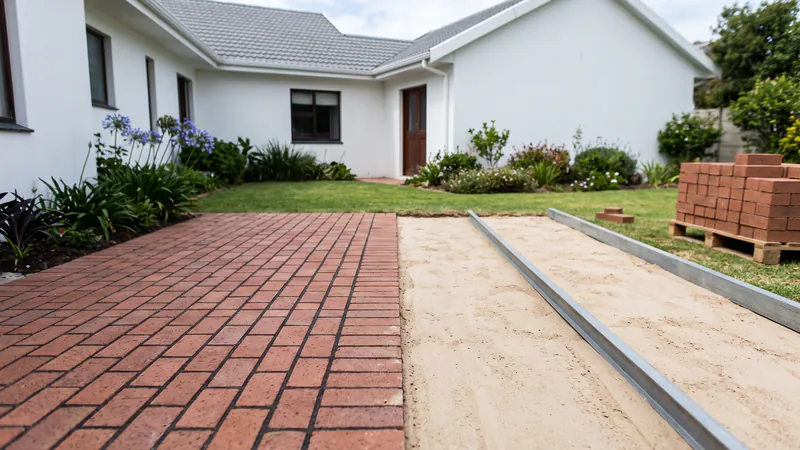
Free measure-up & written quote
We measure, agree the pattern and falls with you, and put an itemised quote in writing. No call-out fee.
Excavation & base
The old surface comes up and the base goes in: compacted G5 under a sand bed, or a concrete base for mortar-set stone and porcelain.
Falls & bedding
Screeded bedding sand for cobble or clay brick, or bedding mortar for stone and porcelain, set to a fall of at least 2% away from the house.
Paving laid & jointed
The paving goes down in your pattern, is cut around steps, planters and drains, and is jointed to suit the material.
Seal, clean & hand over
Sealed where the product calls for it, the site cleaned, and a walk-through of the finished patio with you.
What Patio Paving Costs In Cape Town
We don't publish a per-square-metre rate. The material and the build-up under it both move the price, and your quote itemises both.
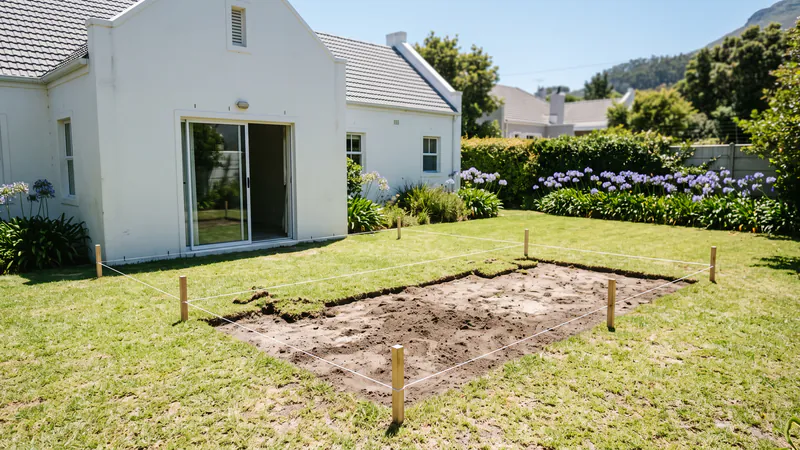
The material
Concrete cobble at the lower end, clay brick a step above it, sandstone and travertine in the middle, and wide-format porcelain at the top.
The build-up
Sand bed or mortar on concrete, and whether a sound existing slab can be reused.
Cuts and details
Every step, planter, drain and pool edge adds cutting and fitting.
Access
A back garden reached only by wheelbarrow costs more in labour than one a bakkie can reverse up to.
A price given off a photograph changes once we arrive, so we measure first. Our cost guide explains why patios, driveways and pool decks price differently.