Paving contractors working across Cape Town — driveways, patios, pool surrounds, garden paths and commercial paving, in cobble, clay brick, sandstone, travertine and porcelain. We measure up at your place, talk through the pavers and the base, then put a clear written price in front of you.

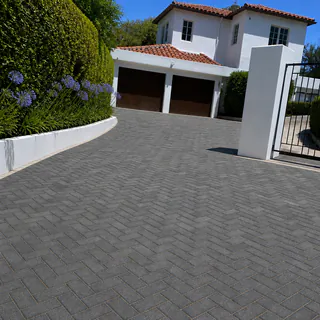
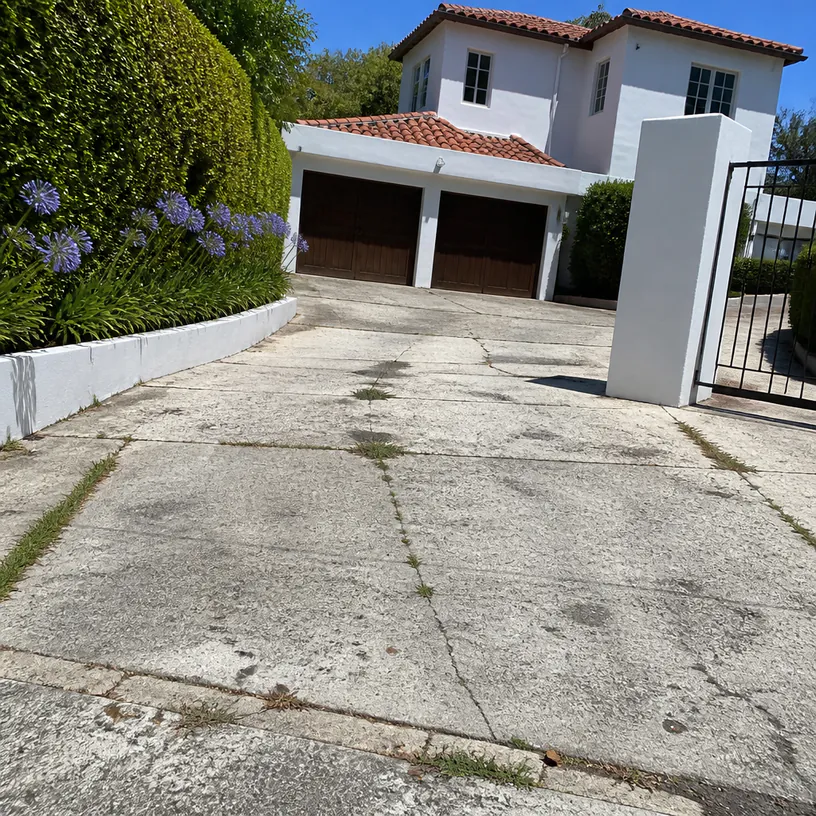
A driveway carries a vehicle over the same strip twice a day, so thickness and base decide how it ages. The Concrete Manufacturers Association calls 50–60mm blocks adequate for domestic use — one band, with no driveway-versus-path split of its own. Taking the 60mm end for anything cars drive on is our call. Herringbone is the CMA’s: it says that pattern resists deformation best.
Learn more →
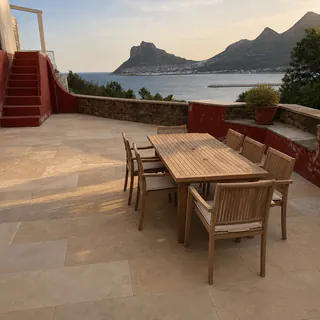
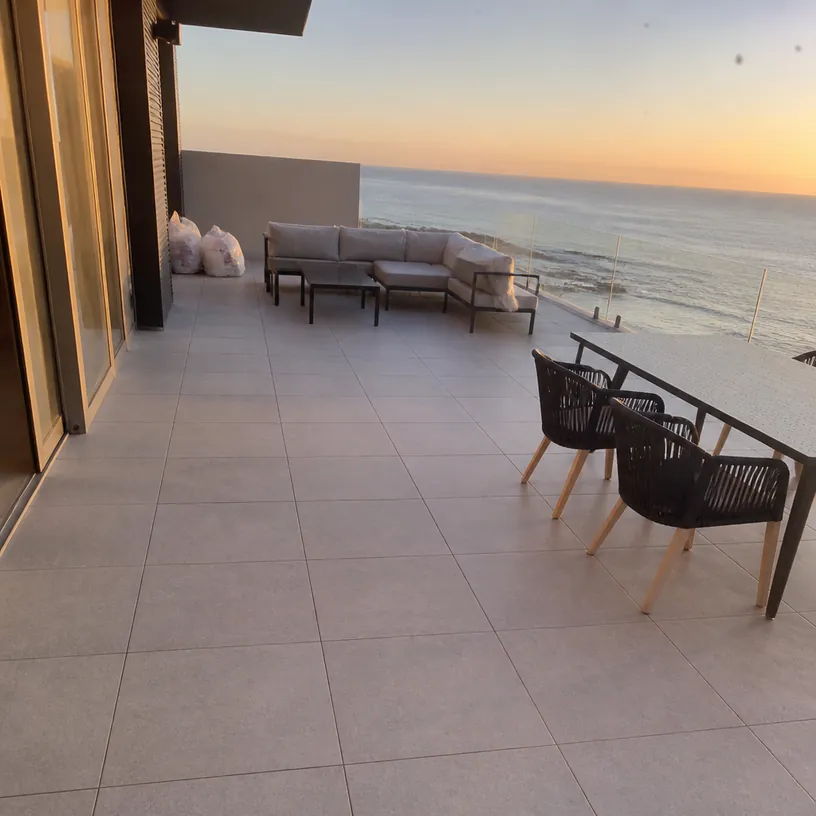
A patio has to shed water away from the house, not towards it, so we set the falls and decide where the water goes at the low edge before anything is ordered. The CMA’s minimum is a 2% fall in any direction. Sandstone, travertine, porcelain and clay brick are the finishes we lay here.
Learn more →
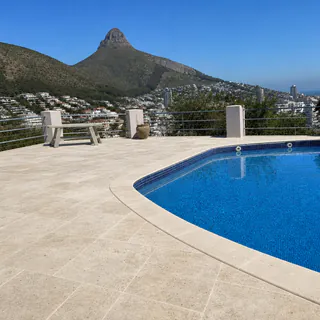
A wet surface with a hard edge, which makes the coping and the edge restraint matter more than the paver does. Travertine, slate, porcelain and clay brick with bullnose coping, set to fall away from the pool rather than back into it. Tell us if the deck also takes a table and chairs — it changes the layout.
Learn more →
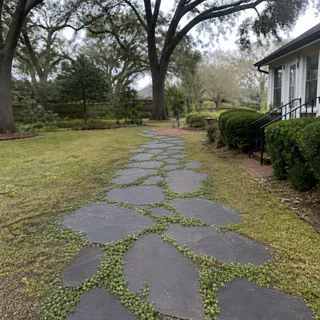
Paths carry almost no load, so we are comfortable at the thin end of the CMA’s 50–60mm domestic band — the band is theirs, that choice is ours — and the budget moves into the layout instead. Stepping stones, flagstone and cobble, set out around planting. Where a mature tree sits close to the line, a modular surface lifts and re-sets rather than being broken out.
Learn more →
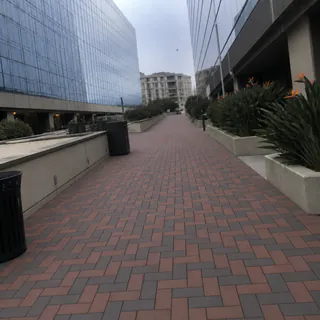
Forklifts and delivery vehicles are a different specification from a home driveway, not a bigger version of one. For industrial use the CMA recommends an 80mm paver, and names herringbone as the pattern it generally recommends for industrial pavements. Yards and loading aprons we phase in sections so part of the site keeps working.
Learn more →
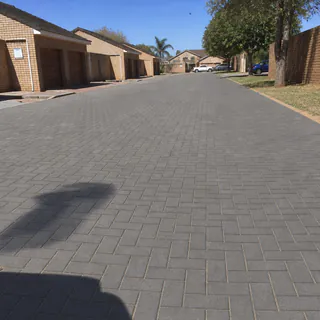
Paving sinking near the garage? We can quote for lifting and relaying the affected section rather than automatically replacing the whole driveway. Poor compaction, water moving through the layers underneath and edge restraint failure are the causes we look for first — a section relaid over the same fault sinks again.
Learn more →Thickness is set by what drives over the surface, not by how it looks. The Concrete Manufacturers Association gives two bands and only two: 50–60mm blocks are adequate for domestic use, and 80mm is recommended for industrial use. That is worth reading closely, because the distinction matters — the CMA treats domestic as one band and does not split a driveway from a garden path inside it. That split is ours, not theirs, and we make it with you on site: in practice the 60mm goes under anything a car drives on, and a 50mm is fine on a garden path. The 80mm for a yard taking delivery vehicles is the CMA’s own recommendation. Pattern counts too, and that one is theirs as well: the CMA says herringbone gives the best resistance to deformation, which is why it goes under wheels.
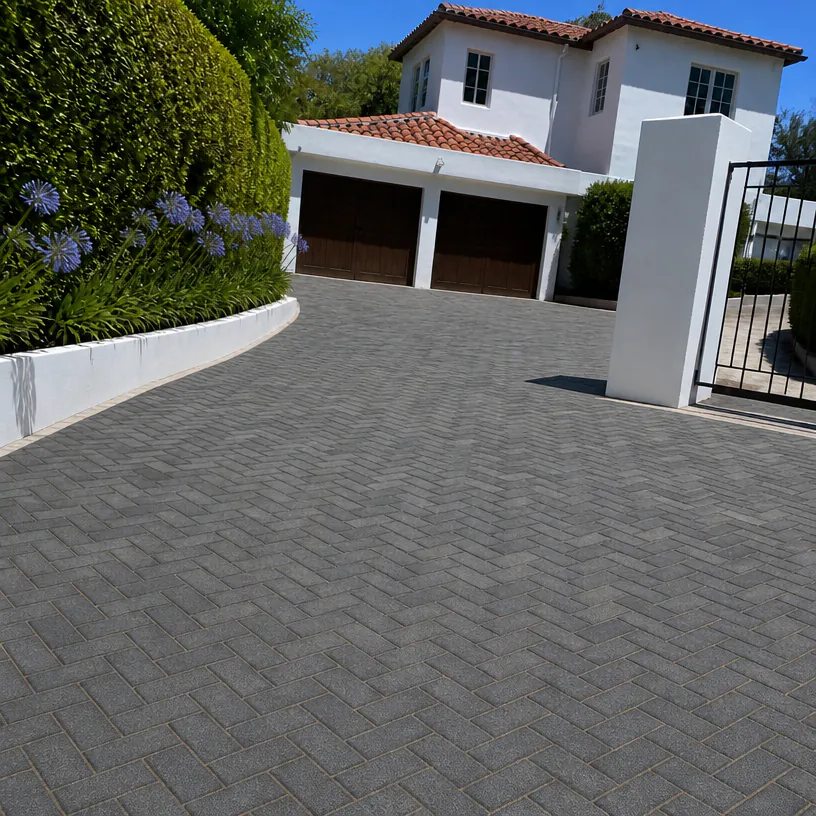
The default for driveways, and the easiest to live with: a damaged block lifts out and a matching one goes back in. On through-coloured products the colour runs the full depth, so a chipped edge shows no pale core. Where a surface may be dug up one day — over a water line or drainage — sand-set blocks are relaid, not broken out.
Fired clay rather than cast concrete. It is what we reach for when new paving has to sit against existing brickwork without fighting it: herringbone where cars drive, basketweave for paths and patios. See a sample dry and wet before you commit — clay reads differently on the ground than in a photograph.
Small units, laid by hand, so more labour and far more joints per square metre than a large-format surface. They go where a big paver cannot: curves, narrow entrances, fan patterns and the apron at a gate. Jointing and joint top-ups matter more here.
Patio and pool-deck surfaces, not driveway surfaces. Less forgiving: large-format units want a flatter bed and cuts around a pool edge have to be right first time. Ask us for a smooth finish on a steep driveway and we will argue you out of it before you order, not after.
We do not publish a rate per square metre, because the same area of driveway can be two genuinely different jobs and one number hides which of them you are being sold. What we can do is name what we are pricing, so you can read any quote line by line.
An old concrete slab has to be broken out and carted away. Grass does not. Often the largest difference between two quotes on one driveway.
Set by what will drive over the surface, and by what we find once the ground is opened. If it comes up soft or wet, the base goes deeper and a separation layer goes in.
The layer that does the structural work, and the one a cheap quote saves on because nobody sees it once the pavers are down. Ask for it as its own line.
Whether a delivery vehicle reaches the work, or pallets are staged at the road and carried in. Access moves the programme more than it moves the paver.
The CMA’s minimum is a 2% fall in any direction. Reaching it on a flat site means building levels up; on a slope, channel drains and steps.
Every curve, manhole, tree ring and gate post is cut by hand. A plain rectangle and the same area wrapped around a pool are not the same job.
The CMA is clear that all concrete block paving must have an edge restraint — but a cast-in-place edge, a precast kerb and an existing wall do not cost the same, and polymeric jointing is a separate line from plain sand.
The paver is one line among those, so a cheaper block leaves everything underneath it unchanged. The long version is on our paving prices in Cape Town page.
The Concrete Manufacturers Association is blunt about the root of it: most failures of pavements are due to ingress of water into the layerwork. Nearly everything below traces back to water, or to the work that was supposed to keep water out.
A dip in the first year or two is the layers underneath, not the pavers. Either the base was not compacted, or bedding sand was used to level out a hollow in it — and the CMA states that bedding sand shall not, under any circumstances, be used for that. It consolidates under load and the dip comes back. Relaying the same pavers over the same fault buys a season.
Block paving works by interlock — the blocks brace against each other — and the edge restraint stops the outside row creeping outwards. The CMA treats it as mandatory: all concrete block paving must have one. Without it the joints open, the interlock goes and the failure works inwards. It is also the easiest item to leave out of a cheap quote, because it is buried on day one.
Weeds are usually growing in what has collected in the joint — windblown soil, leaf litter, dust — not in the base below, so the answer is keeping joints full. The CMA recommends topping them up about three months after construction; polymeric jointing is an option if you would rather not do it by hand. Spraying leaves the empty joint.
Ponding means the surface has no fall, or the fall runs the wrong way. The CMA’s minimum is 2% in any direction. Worth fixing rather than living with, because standing water is the mechanism behind everything above.
The CMA’s finished-surface tolerance is a 3mm maximum difference in level between adjacent pavers, measured three months after the surface opens to traffic. That is a number you can check yourself with a straight edge — on our work or anyone else’s.
Three illustrative before-and-after examples of the paving types we install across Cape Town. These are rendered visuals showing the finishes, not photographs of a completed job. Drag the handle to reveal.
See the paving types we installWe work across the Cape Peninsula and out into the Winelands and the Helderberg. If your suburb is not on this list it is worth asking anyway — the list is where we have written something specific about the work, not a boundary.
Roughly what area, and what is there now — grass, an old slab, paving that has sunk. Photographs help more than measurements. Mention a gate, a manhole, a pool edge or a tree near the line: that is the part that changes the job.
We walk the area, take levels, look at what is under the existing surface where we can, and talk through pavers, patterns and thicknesses with you standing on the spot. This is where the choices actually get made.
The quote sets out the paver, the area, the excavation, the base, the bedding, the edge restraint and the jointing as separate lines — so you can hold it against another quote on like-for-like terms rather than on one bottom-line figure.
The quote is free, it carries no obligation and there is no call-out fee. Start one here.
Free, no-obligation on-site quote. No call-out fee.