A townhouse-complex road, a visitor car park or a refuse-truck route is not a big driveway. It carries heavier vehicles more often, so the paver, base, edges and handover checks need writing down before anyone digs.
Where we stand: the commercial paving we lay is priced from a written quote, not a rate card. Most of the figures below come from the Concrete Manufacturers Association (CMA) Concrete Block Paving manuals — the precast concrete industry’s own guidance, not an independent regulator.
The short version
- Paver: 80mm is CMA’s recommendation for industrial use, and very little is gained above that [1].
- Strength class: the pavement’s performance depends on interlock and is “virtually independent” of block strength above a minimum, so an unnecessarily high class only adds cost [2]. Heavy wheel loads are the exception, so ask your engineer.
- Base: designed by an engineer for your traffic, and tested under SANS 1200 DM and ME [2].
- Handover: Book 3’s tolerances and a flood test, written into the contract [2].
- Contract: a written workmanship warranty plus a defects-liability period. We have found no South African standard that sets either, so both are negotiated.
Why commercial paving is specified differently
More vehicles, heavier vehicles and more turning, so the pavement is designed for the traffic rather than copied from a driveway.
- The design starts from traffic. Catalogue designs classify a road by its traffic and climate, but Book 2 says such methods are “in general, only applicable to roads and not suitable for the design of industrial pavements” [1]. A loading area or refuse-truck turning circle needs an engineer’s design.
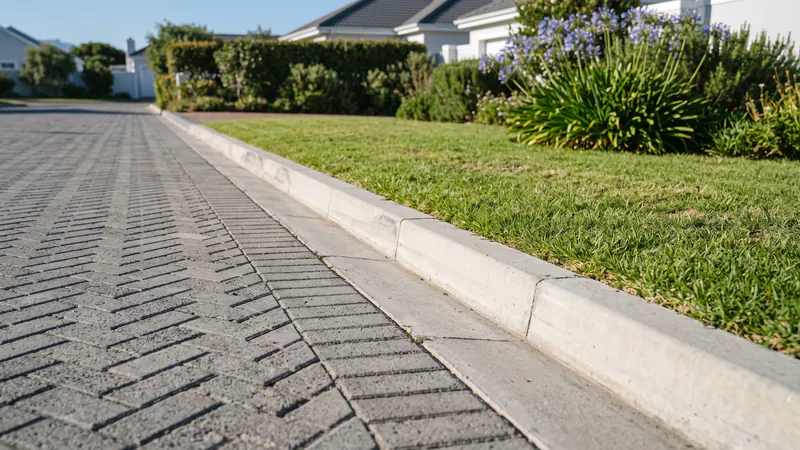
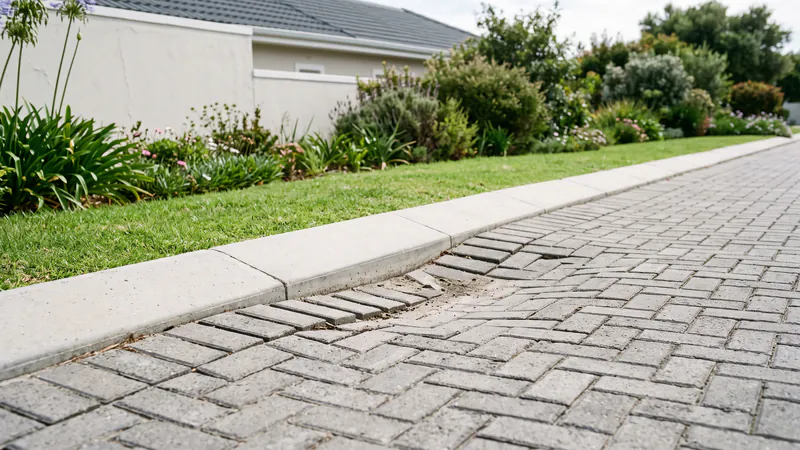
- Edges carry load. A footpath may need only a small precast kerb, but “in a high-traffic industrial area heavy duty concrete kerbs or a reinforced concrete ground beam may be necessary” [1].
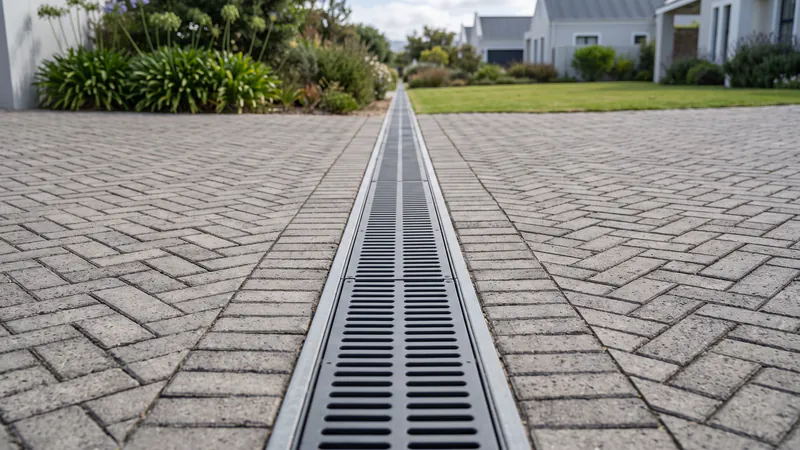
- Water is the usual culprit. “Most failures of pavements are due to ingress of water into the pavement layerwork”; CMA says a minimum 2% fall is generally required, with paving laid 5–10mm proud of stormwater structures [1].
The right paver for the loading
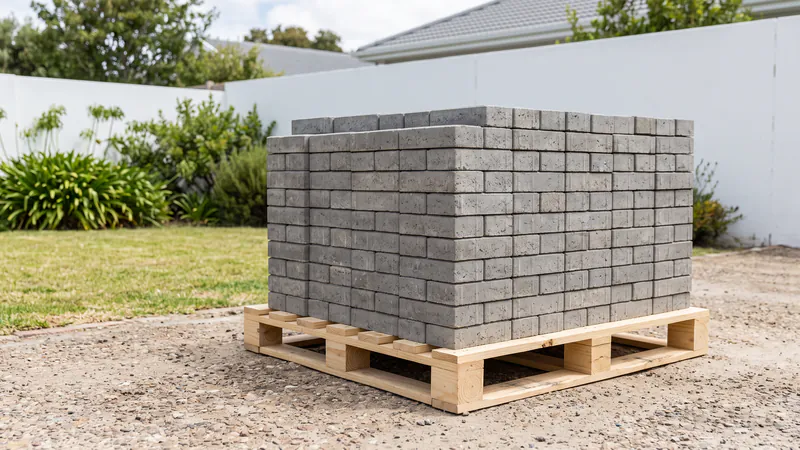
An 80mm interlocking block in herringbone. Blocks thicker than 80mm add little, and a higher strength class earns its cost only under heavy wheel loads or severe conditions.
Worth specifying
- 80mm blocks: “For industrial use an 80mm paver is recommended”, and thicker blocks resist vertical deformation and horizontal creep better [1].
- Type S-A interlocking blocks: “generally recommended for all industrial and heavy-duty applications” [1].
- Herringbone bond: it “ensures the best resistance to both horizontal and vertical deformation and is generally recommended for industrial pavements” [1].
Usually not worth paying for
- 100mm or 120mm blocks: “very little benefit is gained from pavers which are thicker than 80 mm” [1], and the Concrete Society notes those sizes are rarely economical to manufacture [3].
- A higher class “just in case”: “The specifying of an unnecessarily high class will only increase the cost of paving without improving its performance” [2].
Book 3’s clause, reproduced from SANS 1200 MJ, makes the lower of its two classes the default except for paving under wheel loads over 30 kN or where the project specification schedules the higher class, and its commentary adds exceptional loads and severe service or environmental conditions [2]. Those are the historical compressive classes, 25 and 35 MPa, from SANS 1058-1985. Today’s SANS 1058 grades blocks by tensile splitting strength instead — Class 30/2.0 at a 2.0 MPa average and Class 40/2.6 at 2.6 MPa [3] — so ask your engineer which current class to name.
Standards and testing
Name SANS 1058 for the blocks and a specification for the laying, then write the handover checks, and who pays for them, into the contract.
- SANS 1058 covers the block as a product: tensile splitting strength, abrasion (15g average, 20g individual) and water absorption (6.50% average, 8% individual) [3]. It is separate from the specification for laying [2], so a supplier’s certificate says nothing about whether the laying was any good.
- SANS 1200 MJ is, in Book 3’s words, “the standardised specification for civil engineering construction of segmented paving” [2]. SABS technical committee TC 1098 agreed to withdraw the whole SANS 1200 series in April 2016, so it no longer has national standard status, though it can still be bought from SABS [4].
- SANS 1200 DM and ME cover the subgrade and subbase, which MJ refers out to [2]; they went in the same 2016 withdrawal [4]. Book 3’s commentary puts “the strength and the line and level of the layerworks” on the main contractor [2], so say in the contract who builds and tests the base.
Book 3’s finished-surface limits (the first three below) are for Degree of Accuracy I, the only class it gives numbers for, and are measured “3 months after opening to traffic”; its commentary lets them be relaxed for economy, but never the tolerances on the blocks themselves [2]. The rest are construction and testing requirements from the same book.
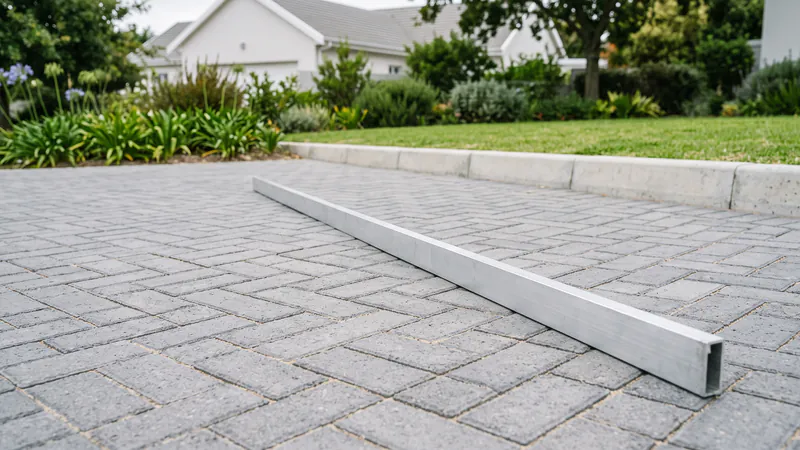
- Adjacent pavers: a difference in level “not to exceed” 3mm [2].
- Under a 3m straight edge: +3mm/−0mm at kerbs, channels, gullies, manholes and other edge restraints, and +10mm/−15mm elsewhere. Book 3’s commentary calls the kerb figure “very difficult to achieve and … not critical provided that adequate falls are met” [2].
- Pattern lines: a joint line strays no more than 10mm from any 3m straight line, and no more than 20mm from any 20m line [2].
- Joints: “between 2 mm and 6 mm”, with a rule of thumb that they “average 3 mm over 20 blocks” [2].
- Base: tested under SANS 1200 DM and ME, with any depressions filled with subbase material “compacted to 98% of modified AASHTO maximum density” — never bedding sand [2].
- Flood test: the engineer may order the surface flooded; the contractor fixes any ponding “at his own expense”, and if none occurs the employer pays for the test [2].
- Heavy traffic: paving regularly carrying wheel loads over 30 kN gets at least five passes of a heavy pneumatic-tyred roller after joint filling [2].
What drives the cost on a commercial job
The engineer’s design for your traffic sets the price, so we don’t publish a rate. Make every bidder price the same separate lines.
We don’t publish a rate for this any more than for any of our other paving work. Ask for these as separate priced lines:
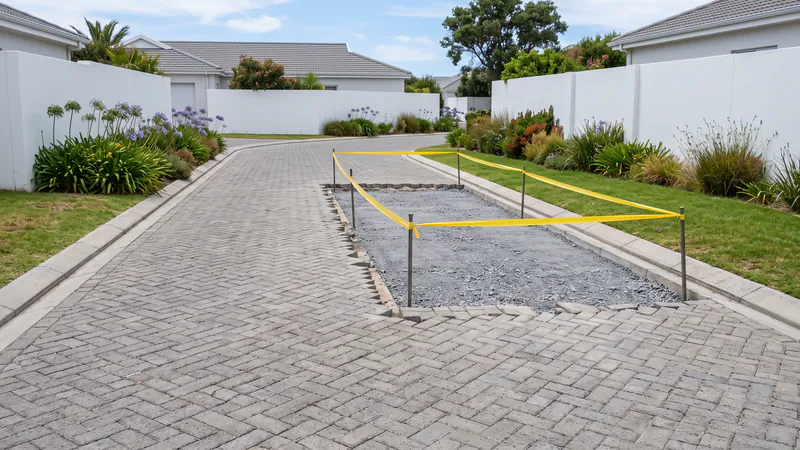
- Demolition and disposal of the existing surface.
- Subbase to the engineer’s design, with the compaction standard named.
- Ground improvement, if the test results call for it.
- Kerbs and edge restraints to a drawing detail.
- Drainage tie-ins to the existing stormwater system.
- Traffic management and phasing on an occupied site.
- Handover testing, with the results in writing.
Whether the job is a gated complex in Century City or an office park elsewhere, an all-in rate can’t be compared line by line with an itemised quote — the same logic as what moves a residential paving price.
The procurement process — what to ask in your tender
Ask every bidder for the same documents, so the prices you compare cover the same work.
Tender checklist: ask every bidder for
- Block certificate: SANS 1058 compliance for the paver they will supply, stating the class [3].
- Detail drawing: subbase, bedding, edge restraint and joint material.
- References: recent commercial jobs, with a contact person you can phone.
- Insurance: proof of public liability and contractor’s all-risk cover at a level your managing agent accepts.
- Warranty terms: the workmanship warranty in writing — duration, what it covers — and the defects-liability period.
- Method statement: phasing and traffic management while residents or tenants keep using the site.
- Test schedule: which of the handover checks above they will carry out, and who signs them off.
Book 3 also lets the first section laid, at least 20m by about 6m, be a trial section the engineer approves before full laying, though its commentary says this need not be mandatory for experienced contractors [2]. In our view, a bidder who can’t produce the checklist isn’t ready for an occupied complex.
Defects-liability period — write it into the contract
Ask for a written workmanship warranty and a defects-liability period on top of it. We have found no South African standard that sets the length of either, so both are negotiated.
- Name the period and when it starts, for example from the signed handover.
- Say what the contractor must come back and fix during it, and how quickly they must respond.
- Make the period run past the three-month mark and walk the site again before it ends, since Book 3 measures finished-surface tolerances three months after opening to traffic [2].
If the base, drainage or edges are not properly designed and built, Book 2 warns “excessive maintenance may be required during the life of the pavement”, and where defects are local, “repairs are not usually difficult, time consuming or costly” [1] — typically lifting and relaying a sunken section.
Common Questions
What thickness paver do I need for a commercial driveway?
CMA Book 2 calls 50–60mm blocks adequate for domestic use and recommends 80mm for industrial use, adding that very little benefit is gained from thicker pavers [1]. In our view a shared road carrying delivery and refuse vehicles should not be specified at the domestic size — confirm the thickness with your engineer.
What's SANS 1200 MJ?
The standardised South African specification for constructing segmented paving; CMA Book 3 reproduces extracts from it [2]. SABS technical committee TC 1098 agreed to withdraw the SANS 1200 series as national standards in April 2016, though the documents can still be bought [4]. It does not cover the subgrade and subbase, which it refers to SANS 1200 DM and ME [2].
How much does commercial paving cost in Cape Town?
We don’t publish a rate, because the price is set by the engineer’s design for your traffic and the ground on your site. Ask every bidder for a full project price with demolition, drainage tie-ins, traffic management and handover testing as separate lines.
How long should a body corporate's paving last?
We don’t publish a service life for any paving. A mechanistic pavement design works from a designated service life and the expected loading [1], so ask your engineer what life the design assumes. Our guide to the faults that shorten a paved surface’s life covers what you can control.
Who pays if commercial paving fails in the warranty period?
Start with the contract: it sets who fixes what and for how long, which is why the warranty terms and the defects-liability period belong in it before work starts. Keep the signed handover test records: they show what the surface measured when you accepted it.
Can our complex stay open during paving?
That depends on its access routes, but work can be phased so one section closes while another stays open. Ask every bidder for a written method statement showing the phases and how residents and service vehicles get in. On our own jobs, phasing and after-hours or weekend work is something we can programme.
Does commercial paving need to be permeable?
Not as a rule: the City’s stormwater by-law does not mention paving, but its stormwater policy can require on-site stormwater measures on developments, particularly larger sites. Where your site’s stormwater design calls for runoff to be handled on site, a permeable build-up is one way to provide it; our permeable paving explainer covers the trade-offs.
Planning work on a complex, office park or retail site? We do a free site survey and follow it with a written quote, and phasing or after-hours work is something we can programme where the site has to stay open. See how we put a quote together, or call 021 825 6396, weekdays 8am to 5pm.
Sources
- Concrete Manufacturers Association — Concrete Block Paving, Book 2: Design Aspects (paver strength, shape, thickness and laying patterns, sec 2.4; drainage, sec 2.7; catalogue and mechanistic design, secs 3.2 and 3.4; edge restraint and construction, sec 4.2). cma.org.za (PDF)
- Concrete Manufacturers Association — Concrete Block Paving, Book 3: Specification and Installation (preface; class, strength and type, sec 3.1.2; subgrade and subbase, sec 5.1.1.1; depressions, sec 5.1.1.2; laying and joint widths, sec 5.4; wheel loads over 30 kN, sec 5.6.2; permissible deviations, sec 6.2; trial section, sec 7.2; foundation testing, sec 7.3; ponding, sec 7.7). cma.org.za (PDF)
- Concrete Society of Southern Africa — The manufacture of concrete paving blocks (2024), sec 2.2 and Table 1: SANS 1058 classes, abrasion and water absorption; block thicknesses. concretesocietysa.org.za (PDF)
- Watermeyer, R — “Withdrawal of SANS 1200 and SANS 10120 as a South African National Standard”, Civil Engineering (SAICE), March 2016, p31. istructesa.org (PDF)