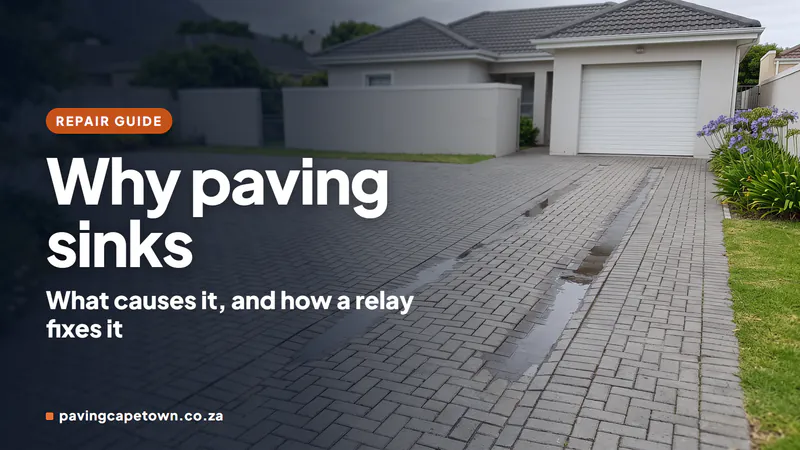
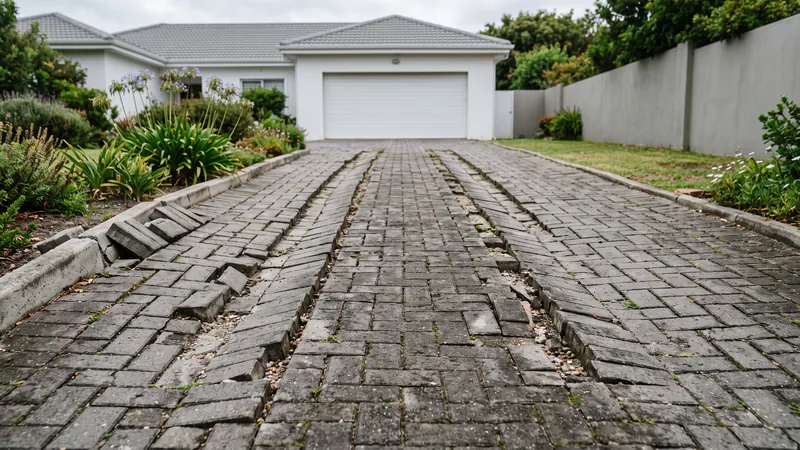
The version homeowners dread goes like this: paid in full on completion day, perfect at hand-over, and by the time the wheel tracks had sunk and the edges had walked sideways, the contractor's phone was disconnected. Most of the shortcuts behind it can be caught before you pay, if you look at the right stages.
Where we stand: this 12-point check is built from what has to be right on any paving we install before it is signed off. The numbers come from the Concrete Manufacturers Association's Concrete Block Paving manuals — the industry's own published specification — not from us. Where the standard sets no number, we say so rather than invent one.
The pre-payment quick check
- Edges: an edge restraint at every perimeter. Walk the line.
- Bond: continuous and tight. Sight along it from a corner.
- Joints: full to the top (finger check), 2mm to 6mm wide and even.
- Levels: no more than a 3mm step between adjacent pavers. Run your hand across the joints.
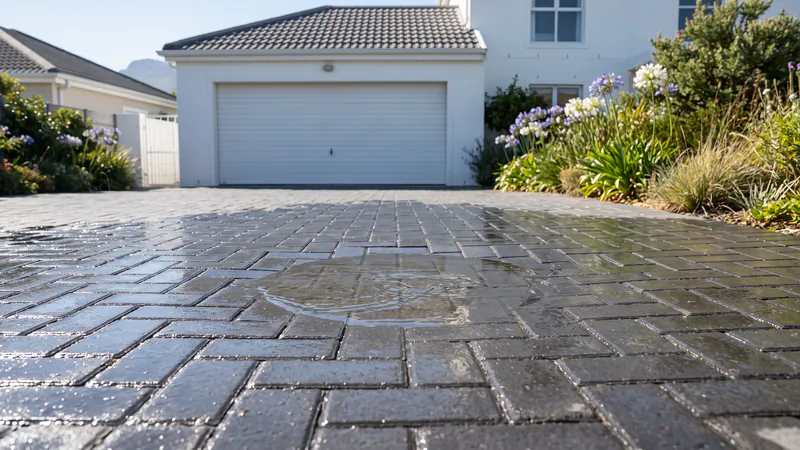
- Water: no ponding once the surface is flooded. Flood it and look.
Before they start: get the spec in writing
Get a written quote that names the base spec, the paver, the joint material and the warranty. "Supply and lay paving" with no spec lines leaves you no contractual leg to stand on when the field starts moving.
- Excavation depth — the figure committed to for your soil and your traffic.
- Sub-base — material, depth and compaction standard, with figures.
- Bedding layer — 25mm of clean sand, compacted; CMA allows a deviation of ±10mm [1][2].
- Paver — brand, model and thickness. CMA Book 2: "Generally for domestic use, 50 - 60 mm blocks are adequate. For industrial use an 80mm paver is recommended" [2].
- Bond pattern — herringbone for anything taking vehicles, stretcher for footpaths and patios.
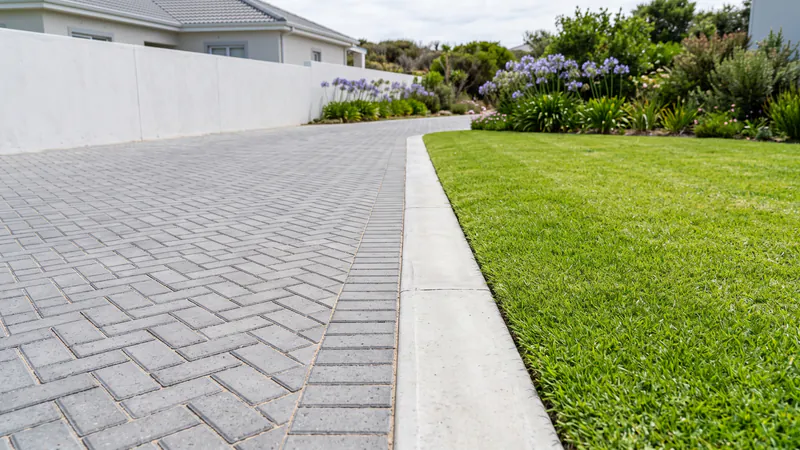
- Edge restraint — the type, and every perimeter it runs along. Book 2: “All cbp must have an edge restraint” [2]; Book 3 accepts an existing concrete pavement, or asphalt at least 100mm thick, in place of a separate one [1].
- Joint material — CMA specifies jointing sand that passes a 1,18 mm sieve with 10–50% passing a 0,075 mm sieve [1], and a finer sand than the bedding layer: “the same sand should not be used in both cases” [2].
- Workmanship warranty — the duration and what it covers, in writing.
During the job: the three site visits that catch most shortcuts
Look after the digging, after the sub-base, and during laying — each time before the next layer hides the last.
Visit 1 — after excavation, before sub-base
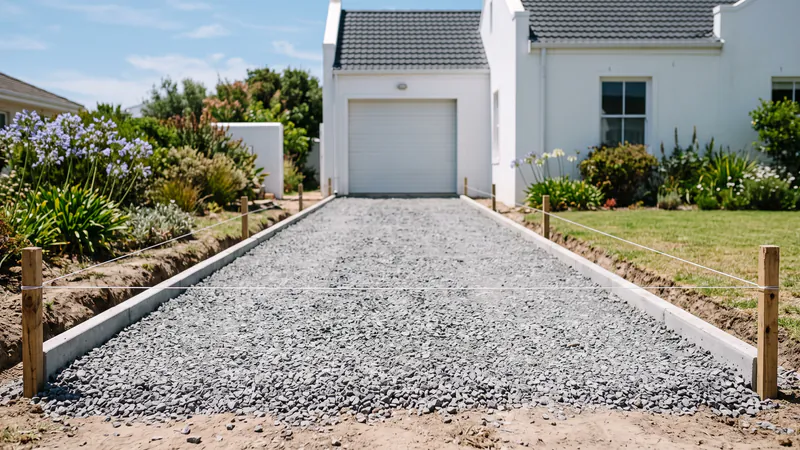
Tape the depth from the existing finished level (top of kerb, garage threshold) down to the dirt. It should equal the paver thickness, plus the 25mm bedding layer, plus the sub-base depth the quote names. If the hole is materially shallower, ask why now, while it's still an empty hole.
Visit 2 — after sub-base, before bedding sand
- Compaction: a deep layer is compacted in stages, so ask how many passes and with what.
- Hollows: Book 3 requires depressions filled with sub-base material "compacted to 98% of modified AASHTO maximum density", and "bedding sand shall not, under any circumstances, be used for this purpose" [1]. This is your only chance to see it.
- Falls: the sub-base must be built so "that surface water cannot pond", with "a longitudinal fall of at least 1% and a transverse fall of at least 2%" [1] — already falling away from the house.
Visit 3 — during laying
- Edges first: Book 3 wants edge restraints "constructed on the subbase (or other formation) before any units are laid" [1]. Edges poured after the field is down are backwards.
- Cutting: a power saw or a guillotine block cutter, the tools Book 3 names [1], not a hammer and bolster, and no tiny cut pieces (see check 9).
- Gaps: even, between 2mm and 6mm (see check 3).
- Setting out: string lines and a level in constant use, not eyeballing.
Sign-off checks 1 to 5: edges, bond and joints
On the day they want their money, walk the perimeter, sight along the pattern and test the joints. Final payment can wait for a proper walk-through.
1. Edge restraints at every perimeter
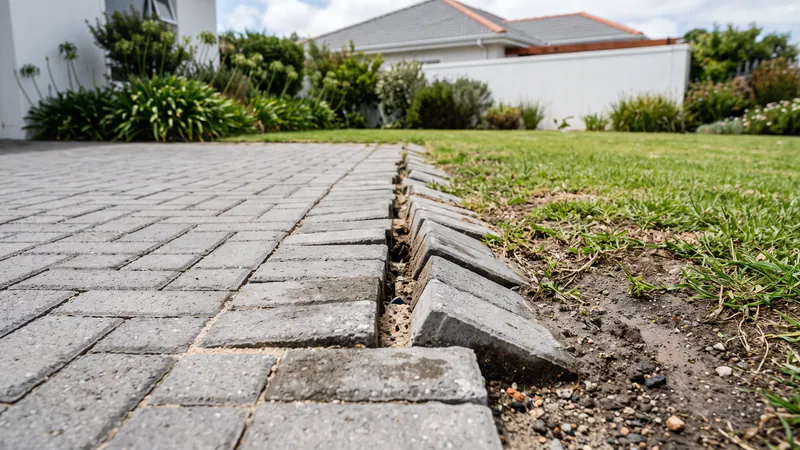
"All cbp must have an edge restraint" [2]. Book 3 says it ensures "that units at the edge of the pavement do not creep outwards or rotate under load with consequent opening of joints and loss of interlock" [1].
- Qualifies: a kerb, a channel or a concrete edge strip.
- The exception Book 3 names: paving that joins an existing concrete pavement, or asphalt at least 100mm thick [1].
- So: every edge against grass, soil, a flowerbed or a gate opening needs one.
2. Bond pattern continuous
Stand at a corner and sight along the bond. The herringbone should run unbroken across the field. CMA recommends turning the pattern to run along an edge restraint [1], so a change of direction at an edge is correct; a break in the middle of the field is what to question.
3. Tight, even joints
"Joint widths shall be between 2 mm and 6 mm", and width "should be as uniform as possible and should average 3 mm over 20 blocks" [1]. A joint that gapes in one place and closes in another is a sign of pavers thrown in without a string line.
- Too narrow "can result in edge and corner spalling under load" [1].
- Too wide will "prevent 'lockup' and load transfer between blocks" [1].
4. Joints filled to the top
Press a finger into a joint: it should meet sand, not a hollow. Jointing sand "shall be broomed into the joints until they are full", and "the procedure shall be repeated until the joints remain full after compaction" [1], because "fully filled joints are essential for the achievement of the full structural performance of the pavement throughout the service life of the pavement" [1].
And "no vehicular traffic shall be allowed over the paving until all joints have been filled with sand" [1] — driving on it first is a defect.
5. Joint sand is finer than the bedding sand
Book 2: “Coarse river sand is ideal for bedding, while a finer plaster sand is necessary for jointing”, and “the same sand should not be used in both cases” [2]. If the joints hold the same coarse sand as the bedding layer, ask for a re-joint.
Sign-off checks 6 to 8: levels, falls and the flood test
No paver more than 3mm proud of its neighbour, water running away from every door, and nothing left standing after a flood test.
6. Levels — the 3mm step and the straight-edge test
Feel along the joints for a paver standing proud. The difference in level between adjacent units is "not to exceed" 3mm [1] — the easiest specification number for a homeowner to check.
- Under a 3m straight edge: no more than +10mm/−15mm away from the edges, and +3mm/−0mm at kerbs, channels, gullies, manholes and other edge restraints [1].
- Pattern lines: a string along a joint line should stray no more than 10mm over any 3m, and no more than 20mm over any 20m [1].
- Timing: CMA measures these "3 months after opening to traffic" [1], so hand-over is an early read — walk it again a few months in. These are Book 3’s tightest accuracy class, and a project specification can relax the finished-surface ones [1].
7. Drainage falls away from buildings
Pour a bucket of water at every door threshold: it should run away, not toward it. At the kerb, water should reach the street drain and not pool in the field.
- Minimum fall: where the tolerances above are allowed, "the fall of the surface for drainage should be steeper than 1 in 50" [1] — 2%, or 20mm per metre.
- At stormwater structures: paving laid 5–10mm proud, so water runs into the gully, not over it [2].
8. The flood test
This is in the specification, not folklore. Book 3 clause 7.7 lets the engineer order "the whole or any part(s) of the surface to be flooded with water to determine whether ponding will occur", and "Rectification of areas where ponding is found to occur shall be carried out by the Contractor at his own expense" [1].
- How: hose from the highest point until thoroughly wet, let it stop running, look for standing water.
- No "acceptable" depth: Book 3's permissible-deviations table sets no maximum puddle depth — ponding simply shouldn't occur.
- Usual cause: "Ponding is generally as a result of incorrect earthworks" [1].
Sign-off checks 9 to 12: cuts, damage, clean-up and paperwork
Clean cuts, no damaged pavers, a clean site and a signed warranty in your hand before the final payment.
9. Cut pavers, not broken pavers
- Clean cuts: Book 3 names “hydraulic or mechanical guillotine block cutters or power saws” [1], so expect a clean cut edge around drains, walls and curves, not a jagged hammer-and-bolster fracture.
- No slivers: "the use of cut units smaller than about 25% of full unit size is not recommended, as these small units can be dislodged under traffic" [1].
- Edge gap: between blocks and edge restraint, the same 2–6mm tolerance [1].
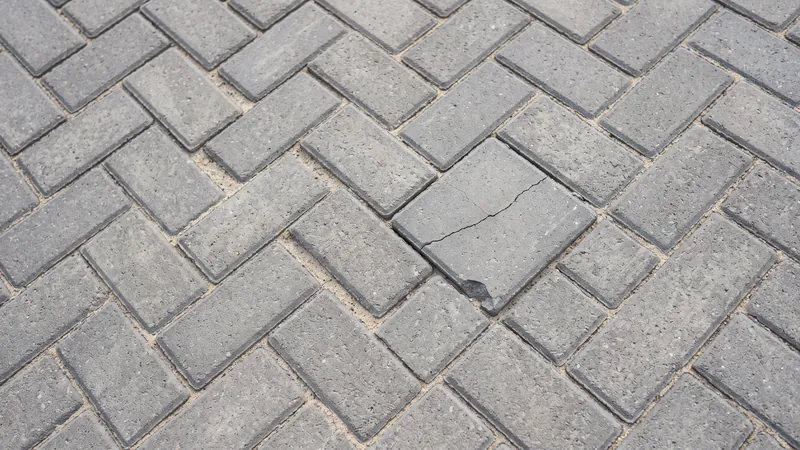
10. No cracked or chipped pavers
"Damaged units shall be replaced and compacted before joint filling is carried out" [1] — during the job, not after you've paid. Don't let "we'll come back next week to swap that one" slide.
11. Site clean
Spoil and pallets gone, no mortar splatter on the walls. The site should look ready to use, not ready to clean up.
12. Written warranty handed over
Leave with a signed workmanship warranty: the duration, what's covered (sinking, edge walk, joint failure) and how to claim. A spoken promise is very hard to prove if it ever comes to a dispute, so get it on paper.
Five red flags that fail the check
- Sub-base skimped: shallower or less compacted than quoted, or hollows packed with bedding sand, which CMA forbids outright [1].
- No edge restraint on any perimeter [2].
- Joints not full after compaction [1].
- Wrong paver class: a lower SANS 1058 class than the quote specifies.
- No written warranty with a stated duration and exclusions.
Red flags during quoting
A big upfront deposit, cash-only terms, a paperless warranty or a price far below the rest.
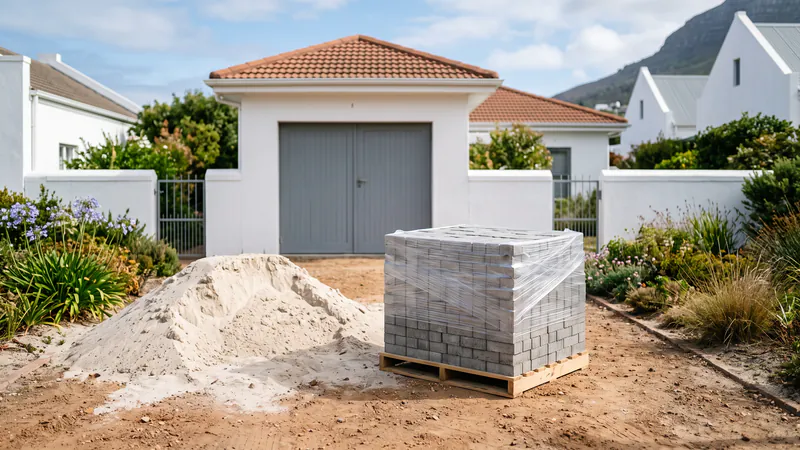
- A large deposit up front. Ask what it pays for; in our view it should be tied to materials arriving on site.
- Cash only. No EFT means no paper trail.
- No verifiable business details. Get the full business name on the quote and, if they trade as a company, its registration number.
- "Lifetime warranty" with no paperwork. Nothing you could prove if it came to a dispute.
- No public liability insurance certificate when asked.
- Quote dramatically lower than the others. A fraction of the price means a fraction of the work in the ground, usually base depth and edge concrete.
- "Sign today" pressure. A deadline that stops you comparing quotes is a sales tactic, not a schedule.
If you've already paid and the work has failed
You can demand a fix or a partial refund, but getting anything back from a contractor who has disappeared is hard — which is why the pre-payment inspection matters.
- Your right: s54 of the Consumer Protection Act 68 of 2008 entitles you to services performed "in a manner and quality that persons are generally entitled to expect"; s54(2) lets you require the contractor to remedy the defect or refund a reasonable portion of the price [4].
- Time limit: none stated in that section. The six-month window people quote is s56(2), for defective goods (plus three months under s56(3) if a repair fails) [4].
- Next step: a formal letter of demand in writing. If that fails, the Western Cape Office of the Consumer Protector takes complaints from consumers in the province.
If the wheel tracks have sunk and the contractor is unreachable, we can quote a localised repair rather than a full replacement. The costliest repairs are the ones left longest; a simple maintenance routine helps catch problems while they are small.
Common Questions
How do I know if my new paving was installed correctly?
Run the 12-point check above; the non-negotiables are edge restraints, full joints 2mm to 6mm wide, no step over 3mm between adjacent pavers, no ponding, and a written warranty. The first four come straight out of CMA Books 2 and 3 [1][2] — the industry’s own specification tolerances, not our opinion.
Should I pay a deposit for paving?
A modest materials deposit once the job is scheduled is normal; a large slice of the job value before anyone has broken ground is a red flag. We’d expect a deposit to be tied to materials and the balance to follow the work, so ask any Cape Town paving company to set that out in the quote.
What does SANS 1200 MJ actually cover?
The long-standing South African specification for segmented paving — but SABS technical committee TC 1098 agreed to withdraw the whole SANS 1200 series during April 2016, so it is no longer a national standard [3], though extracts appear in CMA Book 3. It does not cover the subgrade and sub-base, which fall under SANS 1200 DM and ME and which CMA treats as the earthworks contractor's responsibility, not the paviour's [1]. A withdrawn standard not naming a depth is no reason for your contractor to avoid naming one in writing.
How long should a paving warranty be?
We have not found a South African standard that sets a minimum, so treat the duration as something you negotiate, not something you are owed — and it is only worth having if the base was built right. Get the duration and exclusions in a signed document.
Is there an accreditation I should look for in a paving contractor?
Not for workmanship, as far as we have established: we have found no South African scheme certifying block-paving installation, so ask any "accredited" contractor by whom, and for what. The CMA’s certification company certifies precast products, not the firms that lay them, and its contractor membership is a paid trade membership — "member of the CMA" is accurate, "accredited by the CMA" is not; CIDB registration is real but oriented towards public-sector contracting rather than domestic driveways. Judge them on a written spec, references you actually phone, and these checks.
What should the bond pattern be on my driveway?
Herringbone (90° or 45°) for anything taking vehicles — CMA Book 3 recommends it for roadways and industrial applications, and makes it the default where the block shape permits [1]. Stretcher bond is fine for footpaths and patios. Where herringbone can’t be used, Book 3’s fallback is to lay the units “with the long axis at right angles to the line of traffic” [1].
Can I withhold final payment if I find problems?
The Act doesn’t deal with holding back payment. What s54(2) gives you is the right to require the contractor to fix the defect or refund a reasonable portion of the price [4]. The practical protection is to agree in the quote that final payment follows a snag walk-through, then photograph the issues with dates, send the snag list in writing, and pay once they are resolved.
Job doesn't feel right? We do free on-site assessments across the Peninsula: we show you what is going on underneath and follow with a written quote, with no obligation to use us for the remedial work. Book a paving inspection, or call 021 825 6396, weekdays 8am to 5pm.
Sources
- Concrete Manufacturers Association — Concrete Block Paving, Book 3: Specification and Installation (depressions, sec 5.1.1.2; fall and level, sec 5.1.1.3; edge restraints, sec 5.2; laying and joint widths, sec 5.4; cut units, sec 5.5; compaction and damaged units, sec 5.6; joint filling, sec 5.7; permissible deviations, sec 6.2; ponding, sec 7.7). cma.org.za (PDF)
- Concrete Manufacturers Association — Concrete Block Paving, Book 2: Design Aspects (bedding layer, sec 2.3; paver thickness, sec 2.4; edge restraints, sec 2.6; drainage, sec 2.7). cma.org.za (PDF)
- Watermeyer, R — “Withdrawal of SANS 1200 and SANS 10120 as a South African National Standard”, Civil Engineering (SAICE), March 2016, p31. istructesa.org (PDF)
- Consumer Protection Act 68 of 2008, ss 54 and 56. gov.za (PDF)