Tar, concrete or block paving? All three work on a Cape Town driveway, and each one goes wrong in a different way. The real choice is which weakness you can live with.
Where we stand: paving is our trade. The driveway paving we lay includes block paving and exposed aggregate, a cast concrete finish. We do not lay tar. Every source below is an industry body promoting its own material, so we quote what each one admits, weaknesses included.
The short version
- Block paving can be lifted and relaid when something goes wrong underneath. The joints need topping up and weeding.
- Cast concrete has no sand joints, but it needs control joints every 2.5 to 3m and cars stay off it for about five days.
- Tar is one continuous surface. Its industry’s road-maintenance guidance lists resealing as periodic maintenance, and diesel spills can soften it.
- Whatever you pick, all three sets of guidance look at the ground underneath and where the water goes.
A “tar” driveway isn’t really tar
What we call tar is a bitumen-bound surfacing. The kind compared here is asphalt: crushed stone held together by bitumen.
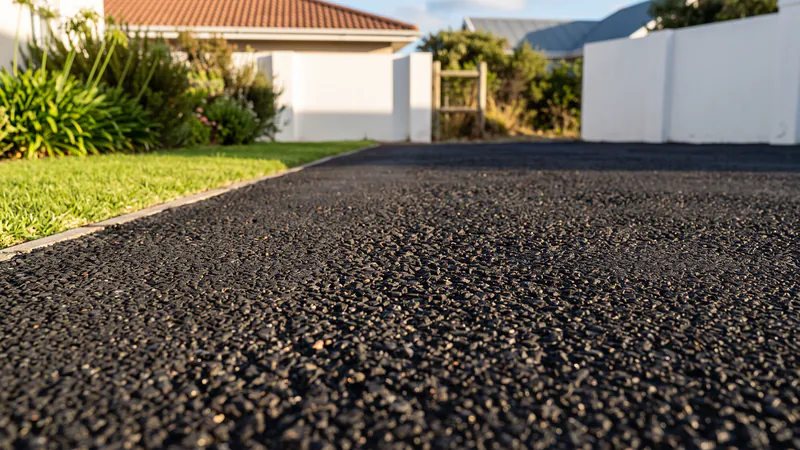
Sabita, the bitumen industry body, is direct about the mix-up: “Bitumen is often mistakenly referred to as tar, which is derived from the gasification of coal and no longer used in the construction of roads due to its toxic properties” [2]. Its safety manual excludes coal tar binders altogether [4].
When you compare quotes, ask the surfacing contractor what the surfacing is and how thick it will be.
What all three look at: the ground and the water
The guidance looks below the surface. The CMA and Sabita warn about water getting into the layers underneath; the Concrete Society wants firm ground and falls that shed rain.
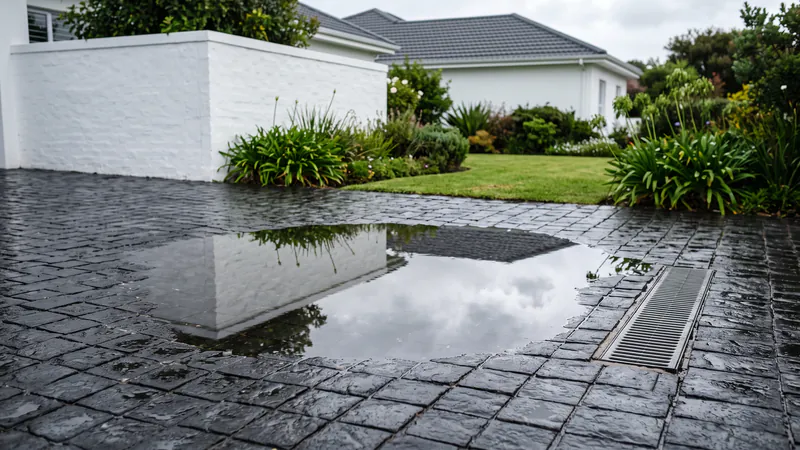
- Paving: “most failures of pavements are due to ingress of water into the pavement layerwork” — the CMA [1].
- Tar: once an aged surface is “brittle and cracked”, water gets into the layers below, and most unstabilised road materials lose considerable strength when wet — Sabita [2].
- Concrete: the ground “must be firm and stable to ensure that it does not settle unevenly at a later stage” — the Concrete Society [5].
Falls: the CMA asks for at least 2% in any direction on paving [1]. The Concrete Society asks for about 1 in 40 (2.5%) across a concrete driveway, sloping away from the garage for at least a metre [5].
On sandy ground with poor falls, any driveway is at risk. That is most of the story behind why Cape Town driveways sink.
| What the guidance says | Block paving | Tar (asphalt) | Cast concrete |
|---|---|---|---|
| What it is | Separate concrete blocks on a thin sand bed, held by an edge restraint [1] | Crushed stone bound with bitumen [2] | A slab cast in place, in panels [5] |
| Weakness the guidance names | Joint sand can wash out in the first months and needs topping up; weeds grow from seeds in the joints [1] | Diesel spills can soften it; a durable mix has to resist binder hardening through oxidation [3] | Random cracking unless joints are formed every 2.5 to 3m [5] |
| How damage is put right | Blocks lifted, the problem fixed, the same blocks relaid [1] | Crack sealing, patching, resealing or an overlay (road practice) [2] | Not covered in the leaflet |
| Before you can drive on it | Not stated in the guidance we read | Not stated in the guidance we read | About five days for cars, ten for heavy vehicles [5] |
There is no lifespan row on purpose. Each body describes durability in its own terms, and we found no independent South African study comparing the three side by side.
Block paving: built to be taken apart
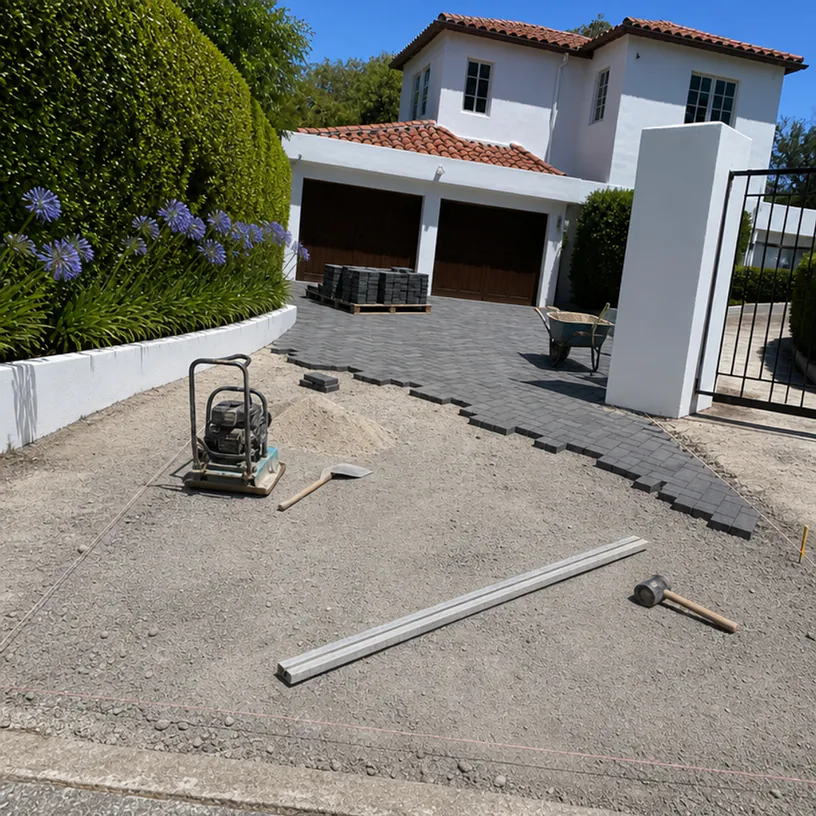
Its big advantage is repair. Blocks come up, the problem underneath gets fixed, and the same blocks go back down.
Good
- Blocks can be lifted for a pipe or cable repair and the paving reinstated afterwards [1]
- A settled area can be lifted, the level reinstated and the pavers re-laid [1] — the everyday job behind our lift-and-relay repairs
- Block paving itself “is not affected” by oil, the CMA says [1]
Watch out for
- Joints should be topped up when required, typically about three months after construction [1]
- In large paved areas, the CMA puts 90% of weed growth down to wind-blown seeds in the joint sand [1]
- Oil stains are hard to get out [1]
- Every block-paved area must have an edge restraint [1]
Ordinary block paving does not soak up rain. The CMA notes that joints “eventually become clogged with road detritus and impermeable to water” [1]. If runoff into the street is your problem, permeable paving is a different build. For the joints, sand and weeds, follow our paving care guide.
Tar: one smooth surface, with upkeep
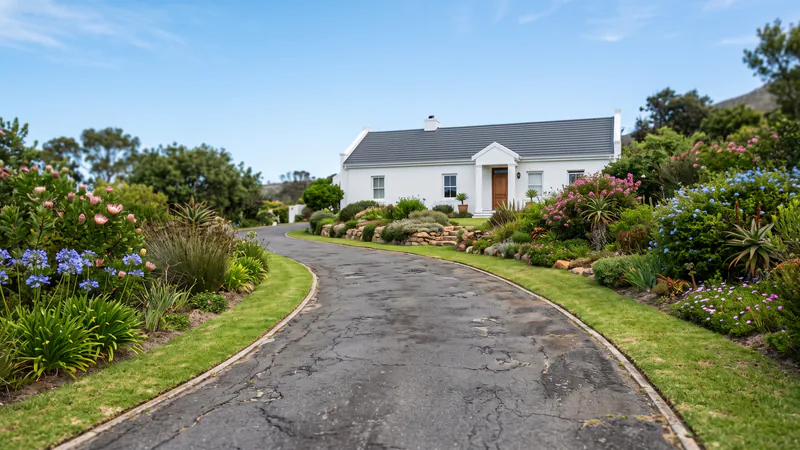
No sand joints to look after, but its industry’s road guidance lists resealing as periodic maintenance, and diesel can soften it.
Good
- One continuous surface, with no sand joints to top up
- The bitumen “acts as a glue to stick the stone together and to waterproof the underlying layers” [2]
Watch out for
- “Spillage of fuel, particularly diesel, can cause softening of the asphalt” [3]
- A durable mix has to resist binder hardening through oxidation [3]
- Road upkeep runs from crack sealing and resealing to patching and overlays [2]
Tar is not work we do. If it is on your shortlist, get a road-surfacing contractor’s view of your site.
Cast concrete: strong and simple, if the cracks are planned
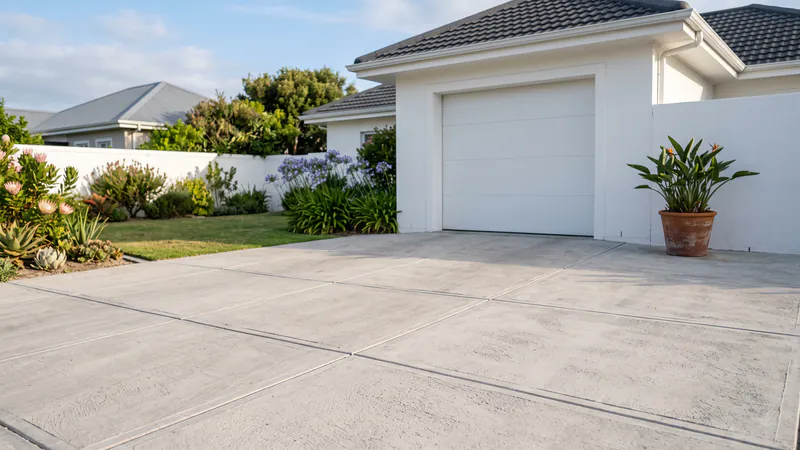
Concrete is expected to crack. A well-built slab is laid in panels so the joints decide where the cracks go.
Good
- A continuous surface with no sand joints
- Strip driveways are “much more economical”, says the Concrete Society [5]
Watch out for
- Joints every 2.5 to 3m, or it cracks at random [5]
- Damp curing for at least 10 days in warm weather, 14 in cold [5]
- Cars only after about five days, heavy vehicles after ten [5]
- A repair means breaking out concrete, and in our experience new concrete rarely matches the old
Built right, per the Concrete Society leaflet: at least 75mm thick, with panels square or nearly so [5]. The strip version is two 600mm strips with centres 1.5m apart, at least 85mm thick, jointed every 1.5 to 2m [5]. Paved wheel strips are the block-paving equivalent, and one of the layouts we suggest for a straight driveway.
So which suits your driveway?
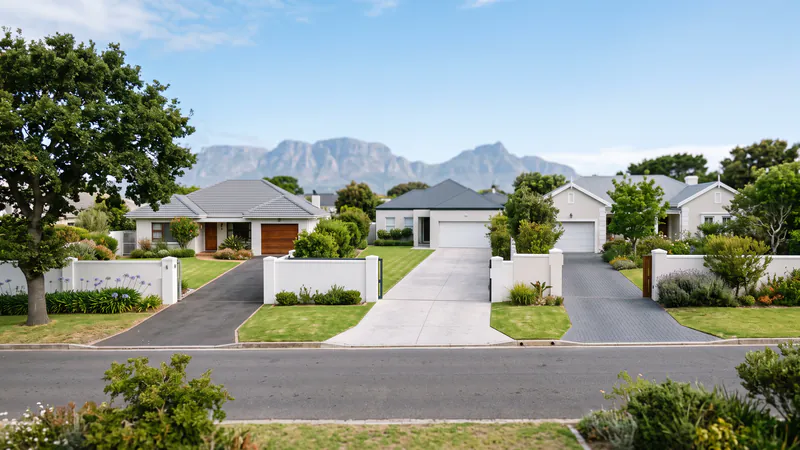
Our view, as a paving business: choose for how you will repair it later, not only for how it looks on day one.
Block paving
Best if the ground moves or pipes may need reaching
Easiest to put right one section at a time. Needs joint care and a proper edge restraint. Next step: charcoal cobble, clay or granite.
Cast concrete
Best for a simple shape with no sand joints
Plan for about five days before a car can use it, and accept that a later repair will show.
Tar
Best if one seamless surface matters most
Expect periodic resealing, keep diesel off it, and ask a surfacing contractor about your site.
Whatever you choose, ask about the ground and the falls first.

Common Questions
Is it cheaper to tar or pave?
We cannot give an honest rand answer, because tar is not work we price. Digging out, removing the old driveway and building up the ground appear on any driveway quote, so ask each contractor to itemise them. Here are the separate lines a paving quote should show.
Is tar better than paving?
Neither wins everywhere. Tar gives a joint-free surface, but Sabita’s manual says diesel spills can soften it [3]. Paving can be lifted and relaid when something goes wrong underneath [1], but its joints need looking after.
What type of driveway lasts the longest?
We do not publish a lifespan ranking. Each industry body describes durability in its own terms, and Sabita’s figures are for the surfacing layer of a road, not a home driveway [2]. The guidance above keeps pointing at the same two culprits: a poor base and water getting underneath, as our guide to how long paving lasts explains.
What are the downsides of having a concrete driveway?
It needs joints every 2.5 to 3m to control cracking, damp curing for at least 10 days in warm weather and 14 in cold, and about five days before a car can use it [5]. In our experience, a repair means breaking out part of the slab.
What are the downsides of tarmac driveways?
Diesel spills can soften it, and a durable mix has to resist binder hardening through oxidation [3]. Sabita’s road maintenance sheet adds that an aged surface left to turn brittle and cracked lets water into the layers below [2].
Should I pave or concrete?
Pave if you want to lift and relay a section later, or if pipes may need reaching. Choose concrete for a joint-free surface on a simple shape, if you can do without the driveway for about five days. We quote both block paving and exposed aggregate driveways, and the rest of the work we take on is on one page.
Want someone to look at your driveway, the ground under it and where the water goes? We measure up for free and give you a written price for the job. Use the form on this page, or call 021 825 6396, weekdays 8am to 5pm.
Sources
- Concrete Manufacturers Association — Concrete Block Paving, Book 2: Design Aspects, fourth edition, 2004 (subbase, sec 2.2; jointing sand, sec 2.5; edge restraints, sec 2.6; drainage, sec 2.7; weed growth, trench reinstatement, settlement and oil stains, sec 6). cma.org.za (PDF)
- Southern African Bitumen Association (Sabita) — Information Sheet 9: Maintaining surfaced roads. sabita.co.za (PDF)
- Sabita — Manual 35: Design and Use of Asphalt in Road Pavements, revised fifth edition, February 2023 (fuel spillage, sec 2.2.3; durability, sec 5.2.2). sabita.co.za (PDF)
- Sabita — Manual 8: Guidelines for the safe and responsible handling of bituminous products (note on coal tar binders). sabita.co.za (PDF)
- Concrete Society of Southern Africa — Lay a concrete driveway at home, 2024 leaflet. concretesocietysa.org.za (PDF)
- Concrete Manufacturers Association — Concrete Block Paving, Book 3: Specification and Installation, fifth edition, 2009 (block strength and interlock). cma.org.za (PDF)